BAUTZEN, GERMANY - A fire broke out on July 21 at a 1.5 MW lithium-ion battery energy storage facility in Bautzen, eastern Germany, forcing local authorities to execute precautionary evacuations and deploy extensive cooling operations. The incident underscores a growing global debate over battery safety standards, containment design, and the protection of first responders during energy storage system (ESS) failures.
The energy storage system, housed across four shipping containers in central Bautzen, required firefighters to pump approximately 5,000 liters of water per minute to cool the structure and mitigate the risk of thermal escalation or explosion. While air quality measurements detected no immediate toxic hazard and no injuries were reported, dozens of residents were evacuated from neighboring areas while operations continued.
Thermal Containment vs. Firefighter Risk
The prolonged response in Bautzen highlights contrasting international philosophies regarding ESS safety and fire management:
1. Traditional Response Challenges: Emergency crews faced significant hurdles due to the volatile nature of lithium-ion fires, relying on continuous external water cooling rather than direct suppression.
2. Containment-First Philosophy: Modern safety frameworks-such as those adopted under stringent U.S. codes and standards (e.g., NFPA 855 / UL 9540A)-increasingly emphasize passive protection. These standards advocate that a thermal runaway event should be strictly confined to a single enclosure or module, allowing the unit to burn out safely without exposing firefighters to life-threatening risks.
"Expecting first responders to risk life and health because a container lacks adequate internal propagation barriers is an unacceptable compromise. True safety begins at the design and testing phase, long before a container reaches the field."
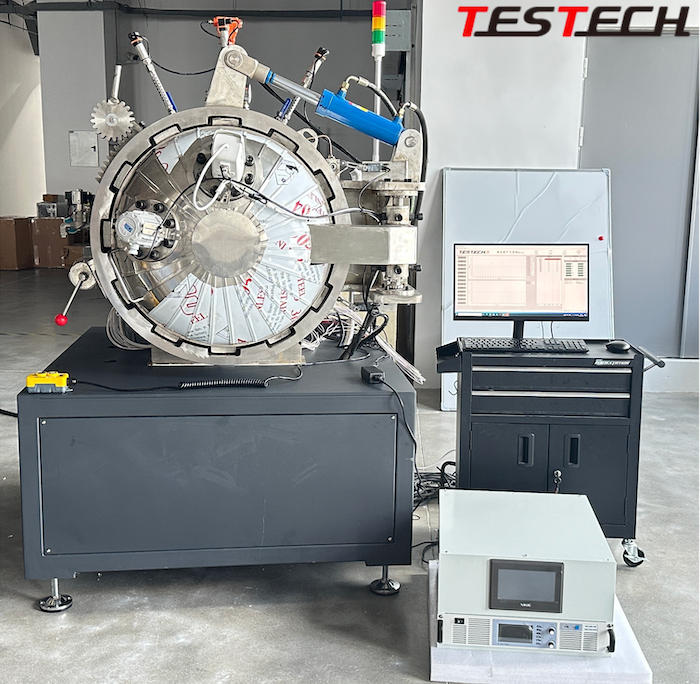
Bridging the Safety Gap: Lithium-Ion Battery Thermal Runaway Test Chamber
To prevent thermal runaway propagation and ensure compliance with stringent international safety standards, battery manufacturers, ESS integrators, and testing laboratories must validate their systems under extreme stress conditions.
Our state-of-the-art Lithium-Ion Battery Thermal Runaway Test Chamber is specifically engineered to help manufacturers evaluate and optimize thermal management and containment strategies:
1. Over-Temperature & Overcharge Simulation: Precisely simulates thermal runaway triggers (overcharging, external heating, mechanical puncture, or nail penetration) in a controlled environment.
2. Propagation Analysis: Enables real-time tracking of heat transfer across cells, modules, and full battery racks to test fire barrier efficacy.
3. Gas & Pressure Monitoring: Measures off-gassing behavior, venting pressure, and toxic flammability limits to design effective explosion relief and containment mechanisms.
4. Safety & Compliance Standard Alignment: Helps integrators certify compliance with global standards, ensuring that failures remain isolated within single units without escalating to full-system fires.
By identifying thermal risks during the product development stage, energy storage providers can implement robust internal countermeasures-protecting local communities, safeguarding high-value infrastructure, and ensuring firefighter safety worldwide.
We are a leading provider of environmental and battery safety testing equipment, dedicated to pushing the boundaries of renewable energy safety. Our comprehensive testing solutions empower energy storage manufacturers, EV developers, and research institutions to build safer, more resilient power systems.
Lithium-lon Battery Thermal Runaway Test Chamber