


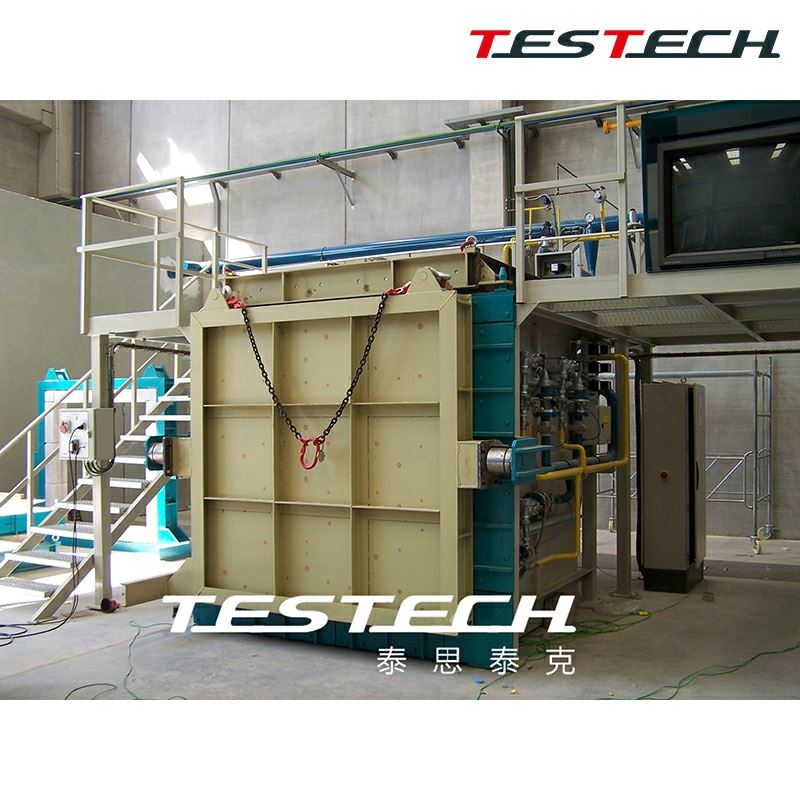
TESTech Instrument (Suzhou) Technologies is one of the leading manufacturers and suppliers of door and shutter fire test furnace in China. Welcome to wholesale premium test equipment at competitive price from our factory. If you have any enquiry about quotation, please feel free to email us.
Product Overview
This furnace satisfies the technical indexes and requirements specified in GB/T 7633-2008 and is suitable for fire resistance testing of non-loadbearing horizontal doors and shutter assemblies.
The furnace design complies with the relevant requirements of EN 1363-1, EN 1363-2 hydrocarbon curve, and ISO 834 for fire resistance testing of building components, and is aligned with the related national provisions.
The equipment has been specially designed and improved over many years to provide a reliable and accurate method for testing various specimen configurations and the necessary combustion chamber components. The furnace can hold different types of restrictive frames containing specimens, and evaluates specimen response to heating under specified time, temperature, and pressure conditions.
The furnace is manufactured, lined, and tested in the factory, then dismantled into transportable sections for trailer shipment according to the preset functions. The furnace wall is coated with hammer blue heat-resistant paint, piping is arranged according to current requirements, and the test temperature can reach up to 1250 C.
Structural Features
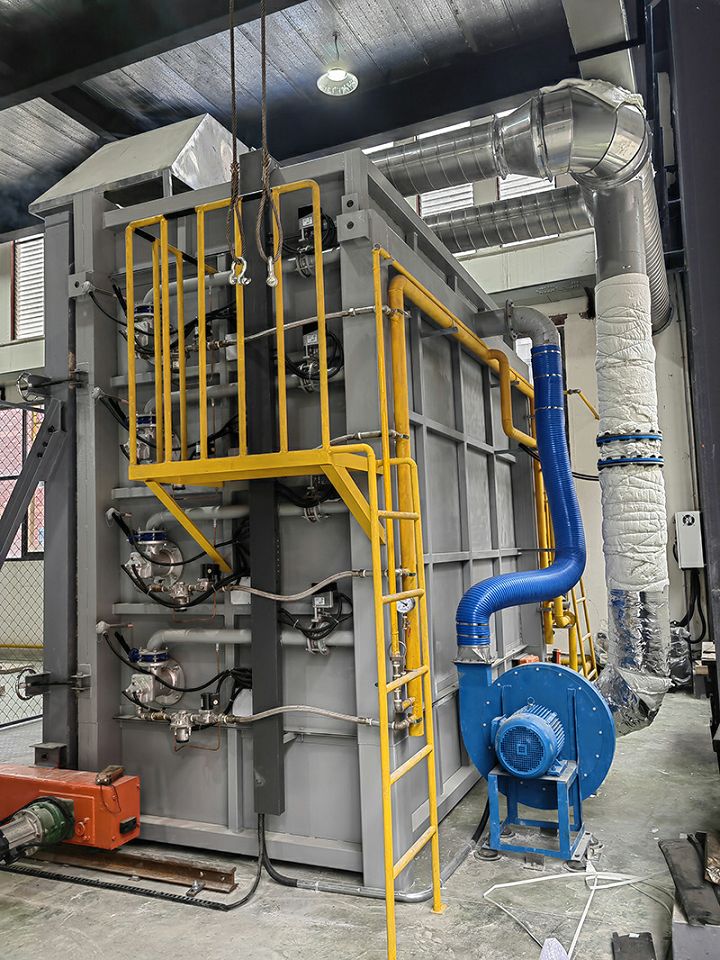
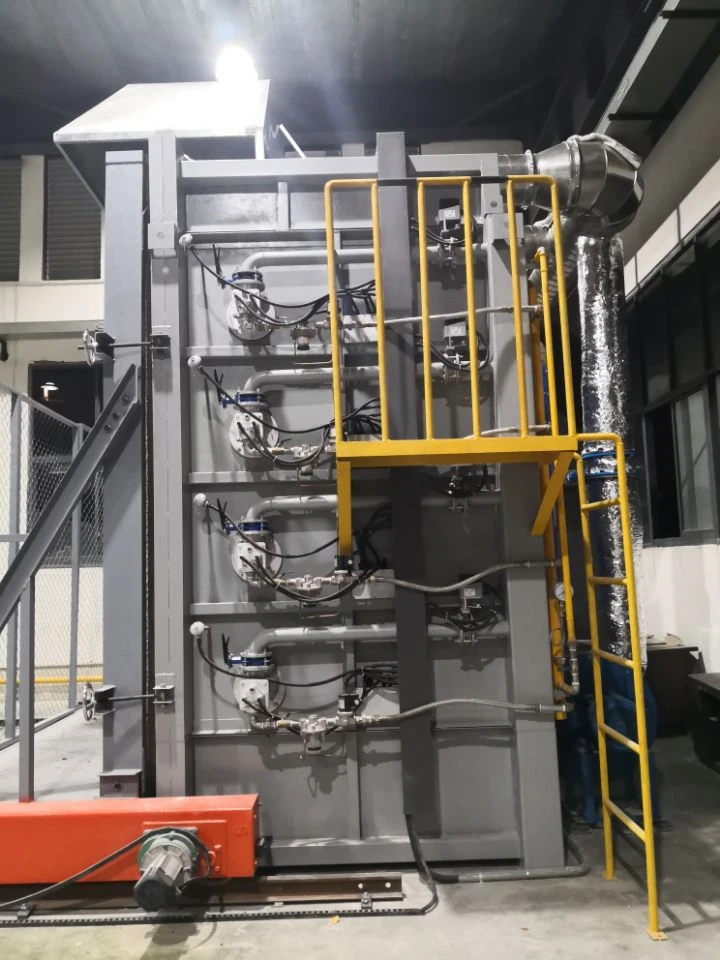
- The furnace is lined with grade 1400 insulating bricks, refractory cast blocks, and slag wool boards. The furnace top is laid with shaped bricks and lined in place with refractory materials.
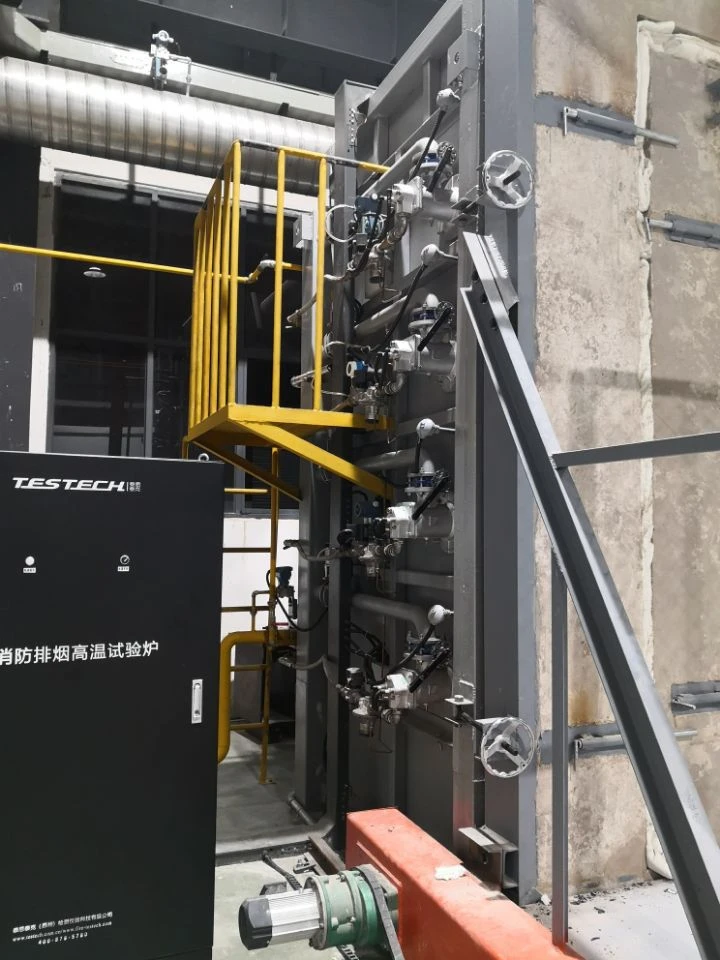
- A non-deforming access door is located at one end wall of the furnace. It is fully lined and equipped with hinges and clamping devices to provide access into the furnace.
- Diatomite insulation and super-insulating low-temperature materials are used in certain areas. In hazardous zones and at all cement-jointed regions of the combustion chamber base, 42% dense alumina refractory bricks are used wherever possible, providing sufficient insulation during a 6-hour high-temperature test.
- The system is capable of both loadbearing and non-loadbearing testing of horizontal specimens fixed on custom mounting frames.
- The furnace wall uses efficient and safe construction, with a refractory cold-face lining made of fireproof insulating bricks, refractory cast blocks, and slag wool boards. The hot face is lined with refractory insulating bricks and high-temperature blocks laid in place.
- The furnace casing uses low-carbon steel plate reinforced with C-channel and I-beams to address thermal deformation.
- The specimen fixing frame is mounted on the furnace front and secured by four sets of clamps.
- The air-cooled insulated frame contains a lightweight aluminum fiberboard sliding door, which can shield furnace heat when the observation opening is not in use.
- The system uses heat-resistant nozzle mixed burners fired by liquefied petroleum gas, equipped with flame monitoring, flame safety systems, intermittent ignition, and temperature sensors.
- The combustion control panel supports both automatic and manual modes. Burners can be ignited automatically according to preset heating curves such as BS 476 Parts 20-24, EN 1363, and the IMO hydrocarbon curve, or manually for selected burners.
- The reinforced furnace structure is designed to be strong and non-deforming, with plate openings for burners, observation ports, thermocouples, pressure points, and monitoring points. The steel frame design ensures service life in the test environment.
Technical Features
- Thermocouples, locations, and design comply with the latest regulations. Nine thermocouple positions are specified in the rear furnace wall, and suitable nickel-iron alloy tubing is supplied for thermocouple support.
- Pressure points, locations, and design comply with the latest regulations. Two nickel-iron alloy tubes are installed on each side of the combustion chamber wall, with T-shaped ends. All pressure points are connected to the site-wired inverter.
- The furnace uses LP gas industrial high-temperature luminous soft-flame burners. Six burners are arranged on each side wall of the upright combustion furnace and are fitted with full flame safety systems, intermittent ignition systems, and temperature sensors.
- The chimney is made of 9 mm low-carbon steel, with the first 6 m lined for high-temperature resistance. It extends at least 3 m above the furnace roof and can also be designed to required specifications.
- The combustion air system is pre-drafted and tested before air delivery.
- The system is equipped with nine K-type thermocouples, one plate thermocouple, one pressure gauge, and one ambient temperature thermocouple.
- A motorized pressure-control damper is used. Gas enters the rear vertical duct through three openings and then flows to a common ground flue. The three dampers are motor-driven and water-cooled to control chamber pressure, and the customer must provide water supply and drainage.
- All solenoid valves, safety control boxes, spark plugs, flame detectors, vacuum and overpressure switches, motorized valves, and safety interlock limit switches are connected by the installation engineers to the site-wired terminal boxes.
- The PLC system consists of a Siemens PLC CPU and Siemens-compatible remote I/O. Fire test data management software is prepared according to customer requirements for collecting and storing test data and meeting the heating requirements of BS 476 Parts 20-24, EN 1363, and the IMO hydrocarbon curve. Other time-temperature curves can also be pre-programmed.
- The PLC controller includes a built-in operating interface with recording and programming capability, as well as all necessary motor starters for the system. The system supports real-time heating curves displayed on the computer screen.
- The furnace can also be operated manually. The complete ignition system does not depend on the control computer. Safety interlocks monitor furnace operation during testing, and each interlock has an indicator light. If an interlock shuts down the furnace, it remains latched until the ignition sequence is manually reset. The system also includes an audible alarm device.
Technical Parameters
|
Parameter |
Value |
|
Operating Voltage |
AC380V +/- 10%, 50Hz |
|
Power Consumption |
6 KW |
|
Furnace Pressure Measurement Range |
0-100 Pa, accuracy <= +/- 3 Pa |
|
Air Flow |
0-50 m3/min, accuracy <= +/- 0.5 m3/min |
|
Fuel Gas |
Propane, liquefied gas |
|
Gas Cylinder Capacity |
50 kg x 6 |
|
Back Surface Radiation Heat Measurement Range |
0-10 W/cm2 |
|
Furnace Internal Pressure |
15 Pa +/- 5 Pa |
|
Programmed Test Temperature |
15 min: room temperature to 718 C; 30 min: room temperature to 821 C; 60 min: room temperature to 925 C; 90 min: room temperature to 986 C; 120 min: room temperature to 1029 C; 180 min: room temperature to 1115 C; 240 min: room temperature to 1150 C |
|
Furnace Temperature |
+/- 15 C |
|
Specimen Internal Temperature |
+/- 10 C |
|
Back Surface Temperature |
+/- 4 C |
|
Temperature Sensors |
Inside furnace: 9 armored nickel-chromium/nickel-silicon K thermocouples, Class II; back surface: 29 armored nickel-chromium/nickel-silicon K thermocouples, Class II |
|
Timing Range |
0-240 min, timing accuracy < +/- 1 s |
|
Usable Area |
3.8 x 2.4 x 4.5 m |
|
Equipment Weight |
4500 kg, on-site installation required |
|
Gasification System |
150 kg/h, optional |
Hot Tags: door and shutter fire test furnace, China door and shutter fire test furnace manufacturers, suppliers, factory


