

If you’re a lab manager, material scientist, or fire safety engineer working across regions with drastic altitude shifts—say, moving between a low-elevation coastal lab in Miami and a high-altitude research facility in Denver, or collaborating with partners in the Andes—you’ve probably wondered: can standard flame spread testers work reliably at different altitudes? As a supplier of fire testing equipment, I hear this question all the time, and it’s one that requires balancing real-world lab constraints, scientific principles, and the unique needs of industries like aerospace, rail transit, and transportation material testing. Let’s break this down, using my team’s years of experience working with labs around the world who test everything from aircraft interiors to train upholstery.
First, let’s get clear on what a Flame Spread Tester does and why altitude matters. A Flame Spread Tester is a specialized instrument designed to measure how quickly and completely a flame travels across a material’s surface, a critical metric for assessing fire risk in everything from building materials to vehicle components. Most standard models (including our core Flame Spread Tester) operate under standard atmospheric conditions: 1 atm pressure, 21% oxygen, and sea-level altitude. But at higher elevations, atmospheric pressure drops—say, 0.83 atm at 1,500m, 0.73 atm at 2,500m, and as low as 0.57 atm at 5,000m. That drop in pressure directly impacts oxygen availability, combustion kinetics, and flame behavior, which means test results from sea-level testers won’t match those from high-altitude labs. Here’s the science: combustion relies on three factors—fuel, heat, and oxygen (the fire triangle). At high altitude, lower air pressure means fewer oxygen molecules per cubic meter, so flames burn cooler, slower, and may even self-extinguish on materials that would fully ignite at sea level. That’s not a flaw in the tester; it’s a mismatch between test conditions and real-world fire risk at altitude.
Now, the big question: can these testers be adapted for labs at different altitudes? The short answer is yes, but it’s not a one-size-fits-all fix. Let’s start with the options labs have, from adjusting test parameters to upgrading their equipment, and when each makes sense.
The first, and most accessible, option is to adjust test methods to align with local atmospheric conditions. For example, many international standards (like ASTM E84, ISO 5658, or railway-specific EN 45545) have provisions for altitude adjustments, but they’re not universal. A lab in Mexico City (2,240m) testing materials for rail transit can’t just plug in standard sea-level settings and get usable data. Rail transit is a key segment for our Rail Transit Material Combustion Tester, and we’ve worked closely with rail operators in places like Bolivia and Peru that run tracks at 3,000m or higher. Their engineers often adjust the oxygen concentration in the tester’s chamber to match local atmospheric oxygen levels (not the standard 21%—Mexico City’s is ~18.9%, La Paz’s is ~15.8%) and tweak the heat flux output to compensate for lower air density. This works for labs that only occasionally test materials at altitude and don’t need cross-regional consistency. But there’s a catch: these adjustments require careful calibration, because even a 0.5% shift in oxygen concentration can change test results by 10-15%. That’s a risk if a material passes at sea level but fails at high altitude, or vice versa.
For labs that need consistent, comparable data across altitudes—say, an aerospace lab testing interior panels that will fly from sea-level airports to high-altitude ones like Denver International (1,655m) or La Paz’s El Alto (4,061m)—adjusting test parameters isn’t enough. Aerospace is another area we specialize in, and our Aviation Vertical Flammability Tester is designed to handle variable altitude conditions, but it can also be paired with modifications for universal testing. Here, engineers use a pressurized chamber inside the tester to replicate sea-level pressure regardless of the lab’s actual elevation. That way, a material tested in Paris (35m) will have identical flame spread results as the same material tested in Quito (2,850m), which is critical for aerospace parts that must meet global regulatory standards. We’ve seen labs invest in this kind of pressurized modification for cross-continental projects, and while it’s more expensive upfront, it eliminates the need to revalidate test data every time a material is tested at a different altitude.
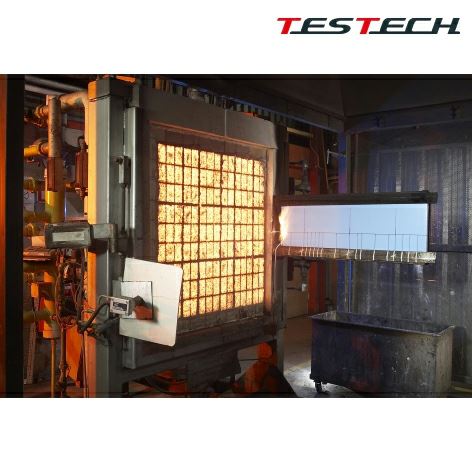
Another factor that comes into play is the type of flame spread tester being used. For example, the Thermal Radiation Flame Propagation Tester relies on a calibrated heat source rather than a direct flame, which makes it more adaptable to altitude changes. Because its heat flux is fixed (a key standard parameter), adjusting oxygen concentration is simpler than with testers that use an open flame. This is a game-changer for labs that need to test materials for space applications or high-altitude drones, where combustion behavior is even more extreme. We worked with a research team in Nepal (1,400m) that used our Thermal Radiation tester to test drone battery enclosures; by adjusting oxygen to match their local air, they got results that matched real-world fire tests conducted at their U.S. headquarters at sea level.
But what about labs that only test for flash point, not flame spread directly? Wait, flash point is related, and the Pensky-Martens Closed Cup Flash Point Tester is used to measure the lowest temperature a fuel gives off enough vapor to ignite. It’s also affected by altitude, because lower pressure lowers the boiling point of liquids, so flash points measured at high altitude are lower than at sea level. While that’s a different instrument, it’s part of the broader fire testing ecosystem, and many of our clients who use our Flame Spread Tester also rely on Pensky-Martens data for fuel systems or industrial chemicals. The same altitude adjustment principles apply here—either calibrate oxygen levels or use a pressurized tester to match standard conditions, which ensures consistent data across locations.
I should also address a common misconception I hear: some lab managers think that if a material passes flame spread at high altitude, it will automatically pass at sea level, or vice versa. That’s not true, and it’s why so many of our clients invest in adaptable testers instead of adjusting parameters on their own. For example, a lightweight fabric used in train seats might burn slowly at 3,000m because there’s less oxygen to feed the flame, but at sea level, it can burn hot and fast, posing a major fire risk. Conversely, a dense material that self-extinguishes at sea level might fully ignite at high altitude because the lower pressure allows volatile compounds to escape more easily. That’s why consistent, well-calibrated testing is non-negotiable, regardless of altitude.
One of the biggest challenges we’ve seen is small labs that operate at high altitude and can’t afford expensive pressurized modifications. For these clients, we recommend two low-cost solutions: first, using portable test kits that simulate atmospheric conditions, and second, partnering with third-party testing facilities at standard altitude that can cross-validate their results. We’ve partnered with a lab in Cusco (3,400m) that tests construction materials for local building codes; instead of buying a modified tester, they send samples to our central facility in Texas (sea level) for cross-testing, which ensures their local data aligns with national standards. This works for labs that don’t need real-time, on-site data for multiple altitudes, but it’s not ideal for time-sensitive projects, like testing new aerospace components that need immediate results.
As a supplier, we’ve learned that one size doesn’t fit all when it comes to flame spread testers and altitude. The key is to match the tester’s capabilities to a lab’s specific needs: if you need cross-regional data for aerospace or rail, invest in a pressurized tester like our Aviation Vertical Flammability Tester; if you only test occasionally at high altitude, parameter adjustments paired with calibration checks will suffice; and if you’re on a tight budget, cross-testing with a standard-altitude facility is a viable middle ground.

At the end of the day, the goal of flame spread testing isn’t just to get numbers—it’s to keep people safe. Whether a lab is at sea level or 5,000m, fire risk is a universal concern, but test conditions must match real-world use. That’s why we’ve spent years refining our Flame Spread Tester line to be adaptable, and our team works directly with clients to troubleshoot altitude-related challenges, whether that’s calibrating a portable tester or guiding a lab through regulatory adjustments.
If you’re a lab working across different altitudes and need to ensure your flame spread test results are accurate and consistent, we’re here to help. We’ve supported labs in over 40 countries, from high-altitude mountain facilities to coastal research centers, and can help you find the right tester or modification for your specific needs. Reach out to our team to discuss your requirements and explore solutions that fit your lab’s unique context.
References
- ASTM E84-22, Standard Test Method for Surface Burning Characteristics of Building Materials, ASTM International, West Conshohocken, PA, 2022.
- ISO 5658-2:2018, Reaction to fire tests—Spread of flame—Part 2: Lateral spread on building products under exposure to a radiant heat source, International Organization for Standardization, Geneva, 2018.
- EN 45545-2:2020, Railway applications—Fire protection on railway vehicles—Part 2: Requirements for fire behaviour of materials and components, European Committee for Standardization, Brussels, 2020.
- Babrauskas, V., “Flame Spread Across Solid Fuels: A Review of Models and Data,” Fire Safety Journal, vol. 38, no. 3, 2003, pp. 251–282.
- Quintiere, J. G., “Principles of Fire Behavior,” 2nd ed., CRC Press, Boca Raton, FL, 2018.