

If you’ve ever worked with composite materials—those dynamic blends of polymers, fibers, and fillers designed for everything from aircraft interiors to automotive body panels—you’ve likely wondered about one critical question: can a standard flame spread tester actually assess their fire performance? As a supplier of fire testing equipment, I field this question at least once a week, and for good reason. Composites aren’t like homogeneous materials such as steel or pure plastic; their layered structures, mixed compositions, and unique physical properties mean their fire behavior is far more complex. To give you the straight answer, we need to break down what a flame spread tester does, how composite materials differ from traditional test samples, and why our team’s approach to designing testing tools makes all the difference.
Let’s start with basics: a flame spread tester is engineered to measure how quickly a flame travels across a material’s surface when exposed to a standardized heat source. For decades, these machines were calibrated for simple, uniform materials—think solid wood, upholstery foam, or single-layer plastics. But composites changed the game. Take carbon fiber-reinforced polymer (CFRP), for example. Its carbon fibers are highly conductive, so when a flame hits, heat can spread laterally through the fibers much faster than through the polymer matrix. That’s a behavior a standard flame spread tester, which often uses a flat, even heat source, might miss if it doesn’t account for directional heat transfer.
Don’t get me wrong—flame spread testers can work for composites, but only if they’re designed to adapt to the material’s unique structure. A one-size-fits-all machine will give misleading results, which is why so many manufacturers of composite parts have reached out to us frustrated by faulty test data. They’ll run a test on a generic flame spread tester, get a number that doesn’t match real-world fire performance, and end up reworking their entire production line unnecessarily.
Let’s get specific about why standard testers fall short for composites. Imagine a composite material used in locomotive interior panels. Locomotive fire safety regulations require precise flame spread measurements, and composites here are often layered with a fire-retardant core and a decorative outer layer. If you test this on a standard flame spread tester, which only applies heat to the outer surface, you might not catch that the core layer releases toxic fumes when heated, or that the flame travels between layers through delamination. That’s why our team developed a range of specialized tools, including the Locomotive Material Combustion Tester, which is calibrated explicitly to test layered transport materials exactly like these. This machine applies controlled heat from multiple directions and captures both surface flame spread and internal layer degradation—something a standard flame spread tester can’t do.
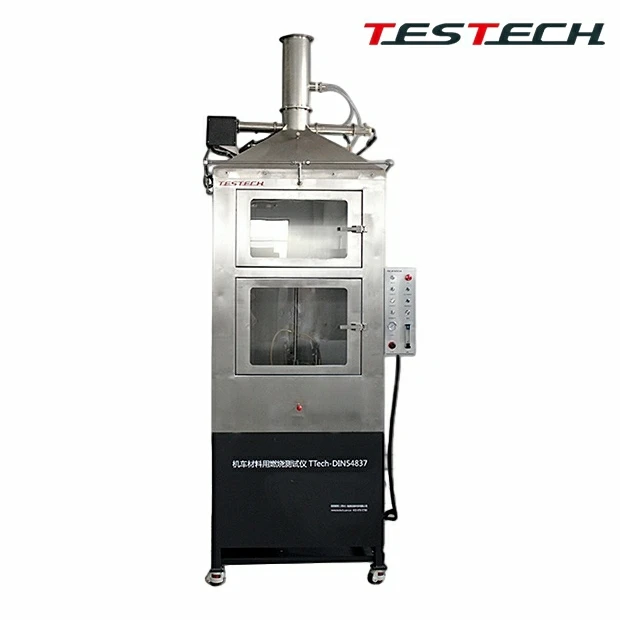
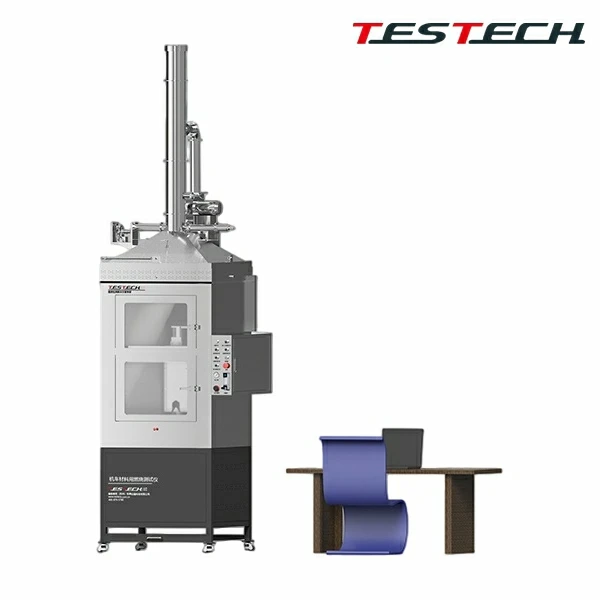
Another common composite application is adhesive tapes used in aerospace assemblies. These tapes are thin, often multi-layered with a pressure-sensitive adhesive and a reinforcing fabric, making their fire behavior very different from solid tapes. A standard vertical flame test might only measure how the outer tape burns, but not how the adhesive layer drips or spreads flame along the surface. That’s where the Adhesive Tape Vertical Flammability Tester comes in: it’s designed to hold thin, flexible samples under controlled tension, mimicking how these tapes are actually installed in aircraft and trains, so the flame spread data is accurate for real use cases.
But it’s not just about adapting to shape—composites often undergo thermal decomposition before they catch fire, and that decomposition can release flammable gases that drive flame spread. A standard flame spread tester might measure surface flame length, but not the rate at which these gases are released. That’s why we pair our flame spread tools with systems like the Tube Furnace Decomposition Systems. These are integrated into our testing setups to heat composite samples in an oxygen-controlled environment, measure the exact composition and volume of gases released, and let you correlate that data to how quickly a flame will spread. For composites, this link between thermal decomposition and flame spread is non-negotiable, and a basic flame spread tester can’t capture it.
I’ve seen this play out firsthand with a client that makes composite seat backs for commercial aircraft. They were using a standard flame spread tester that gave them a flame spread index (FSI) of 25, right within the regulatory limit. But when they tested their sample on our Aircraft Seat Flammability Test Apparatus—purpose-built for the unique geometry of aircraft seat components—they found the actual FSI was 42, which would have failed their certification. The discrepancy? The standard tester tested a flat 1x1 foot sample, but real seat backs have curved edges, layered foam, and composite panels that allow flame to spread around corners much faster. Our apparatus replicates that exact geometry, so the data matched what would happen in an actual aircraft fire.
So, to circle back to the original question: yes, a flame spread tester can test composite materials—but only if it’s not a generic unit. Composites are inherently variable, so any testing tool needs to account for their layered structure, directional heat transfer, thermal decomposition, and real-world installation geometry. That’s why suppliers can’t just grab any off-the-shelf flame tester; they need equipment tailored to the specific composite application, whether that’s locomotive panels, aircraft seats, or adhesive tapes.
Now, let’s talk about how to choose the right tool for your composite materials. First, ask yourself: what is this composite going to be used in? If it’s for transportation (air, rail, road), your test needs to comply with strict regulations that require testing in the actual form of the part. That means you might need something like the Electrical Burner Test Machine, which uses an open flame source calibrated to transport industry standards, rather than a radiant heat source that doesn’t replicate real ignition. Second, look for a tester that lets you adjust parameters like heat intensity, oxygen level, and sample orientation—these are all critical when testing composites that behave differently at varying angles. Third, make sure the equipment can capture not just surface flame spread, but also secondary effects like delamination, gas release, and smoke density—all of which impact how a fire spreads in a closed space like a train cabin or aircraft fuselage.
I’ve worked with clients who thought they could save money by using a standard flame spread tester for composites, only to have to re-test every batch of parts at a third-party lab. That ends up costing them time, money, and delays in getting their products to market. Investing in a specialized flame spread tester designed for composites is a one-time cost that saves you from those headaches.
If you’re a composite manufacturer trying to validate your products, or a tester looking to upgrade your equipment for complex materials, the right partner can make all the difference. We’ve spent years refining our tools to address the unique challenges of composites, from locomotive components to aircraft interiors, and we’re here to help you get accurate, reliable data that meets regulatory requirements. Whether you need to test a small batch of prototype composite samples or scale up for full production, our team can guide you to the right equipment for your specific needs.
Ready to find the right flame testing solution for your composite materials? We’re here to help you every step of the way.
References
- ASTM E84, Standard Test Method for Surface Burning Characteristics of Building Materials.
- ISO 5658-2, Reaction to Fire Tests—Spread of Flame—Part 2: Lateral Spread on Vertical and Small Inclined Samples.
- NFPA 130, Standard for Fixed Guideway Transit and Passenger Rail Systems.
- FAR 25.853, Fire Protection: Materials, Parts, and Components.
- European Standard EN 45545, Railway Applications—Fire Protection on Railway Vehicles.