


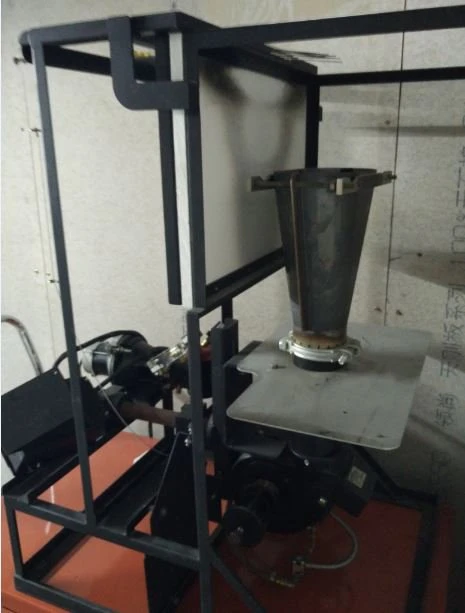
TESTech Instrument (Suzhou) Technologies is one of the leading manufacturers and suppliers of aircraft fire penetration tester in China. Welcome to wholesale premium test equipment at competitive price from our factory. If you have any enquiry about quotation, please feel free to email us.
Product Introduction
With the increasing maturity of aviation technology, greater attention is being paid to the flammability testing of aviation materials. Internationally used aviation fuel burners are also being more widely adopted for testing a variety of materials used in aerospace vehicles.
This aircraft material flame combustion tester is designed and developed according to relevant international and domestic standards, using a large imported American gas burner and corresponding standard-based design principles. It is increasingly adopted by authoritative aviation research institutes in China.
The equipment is a multifunctional combined test bench. It can perform combustion tests using both a large combustible gas burner and a small gas burner on onboard equipment, accessories, and structural parts in designated aircraft fire zones, including cables, electrical connectors, hoses, and pneumatic components.
The latest second-generation burner from TESTech is newly designed according to the latest FAA requirements. It addresses the discontinuation of the first-generation prototype burner and the instability in temperature and heat output of the first-generation design. This burner fully satisfies relevant FAA requirements for fire testing of different aircraft materials.

Aircraft Cargo Compartment Liner Panel Burnthrough Test Device
The aircraft cargo compartment liner panel burnthrough test device consists of an aviation burner, burner support, mobile platform, temperature calibration device, heat flux calibration device, gas supply system, fuel supply system, control and data acquisition system, and computer.
1. Burner
- The burner uses a stainless steel structure and consists mainly of an air pressure regulator, turbulence generator, combustion duct, fuel pipe, igniter, silencer, and conical burner outlet.
- Equipped with an imported American silencer to avoid the harsh noise generated by high-speed air.
- Combustion duct and fuel pipe are stainless steel, offering high-temperature resistance, corrosion resistance, and a neat appearance.
- A spark plug is installed at the nozzle and an automatic ignition device is adopted for safety and convenient operation.
- The conical burner outlet is made of stainless steel for high-temperature resistance, corrosion resistance, and deformation resistance. Material thickness is 1.650 ±0.375 mm, length 305 ±3 mm, opening height 152 ±6 mm, and width 280 ±6 mm.
- Equipped with a laser level for accurate observation and calibration of preheating, calibration, and test positions.
- Equipped with an imported high-precision angle level for convenient direct observation of burner rotation angle.
2. Burner Support
- Precision-machined burner support assembly with attractive corrosion-resistant finish and reliable support for the burner.
- The burner support is installed on the mobile platform and automatically moves to ignition, temperature calibration, heat flux calibration, and test stations.
- The burner automatically changes angle and can perform tests at 0 degrees, 45 degrees, 90 degrees, and other positions.
3. Mobile Platform
- The mobile platform is welded from I-beam steel for stability and strength.
- The platform is equipped with electric guide rails and positioning switches for smooth movement of the burner support and burner to different calibration or test stations with accurate positioning.
- Configured with a drag-chain mechanism to protect control cables.
- All power and data lines are packed in cable carriers and move with the guide rail, ensuring a neat and safe test circuit.
4. Burner Air Supply System
- Air compressor and air storage tank to be provided by the customer.
- Stable gas supply with touch-screen control, clean and oil-free operation, low noise, and easy use.
- Imported American silencer reduces harsh noise caused by high-speed air.
- Large-flow solenoid valve automatically supplies or stops air according to operating status.
- Air supply pipeline uses hose connection for easy movement with the burner.
- During testing, dry air with stable pressure and flow above 0.6 MPa is continuously supplied.
- Air pressure regulator uses an imported high-precision pressure regulating valve with 0 to 0.8 MPa adjustment range.
- Burner air nozzle uses an imported nozzle to ensure stable air pressure-flow ratio and no error in gas velocity and flow during testing.
5. Burner Fuel Supply System
- The fuel supply system mainly consists of a pressure-stabilizing gas tank, fuel storage tank, fuel filter, imported flow meter, and solenoid valve.
- Fuel supply pressure and flow are stable, fuel atomization is sufficient, and tank capacity meets more than 30 minutes of testing; different tank capacities can be customized according to required test duration. Fuel is customer supplied.
- The system is equipped with a high-purity nitrogen device and a high-precision decompression valve to continuously provide stable fuel pressure from 0 to 1 MPa.
- Equipped with a stainless steel high-pressure pressure-stabilizing gas tank to effectively maintain fuel supply pressure.
- Equipped with a stainless steel fuel storage tank rated for 2 MPa, suitable for long-duration combustion tests, with a liquid-level alarm system for real-time fuel monitoring.
- Equipped with fuel filter, pressure collector, and fuel temperature collector for real-time collection of fuel-related parameters.
- A high-precision regulator is used to finely adjust any oil pressure within 0 to 0.8 MPa according to test requirements, ensuring stable fuel flow and pressure.
- Imported fuel nozzle provides good atomization, complete combustion, and stable flame during testing.
6. Heat Flux Calibration System
- Uses a total heat flux foil-type Gardon heat flux meter with range 0 to 17 W/cm2 and accuracy ±3 percent.
- During calibration, the heat flux meter is mounted on an insulating board 305 ±3 mm long, 152 ±3 mm wide, and 19 ±3 mm thick.
- The heat flux meter and insulating board are mounted above the support, 203 ±3 mm from the burner conical outlet and located on the centerline of the cone.
- Configured with a water-cooling system including tank and pump, with automatic water-cooling startup protection to prevent damage to the heat flux meter.
7. Flame Temperature Calibration System
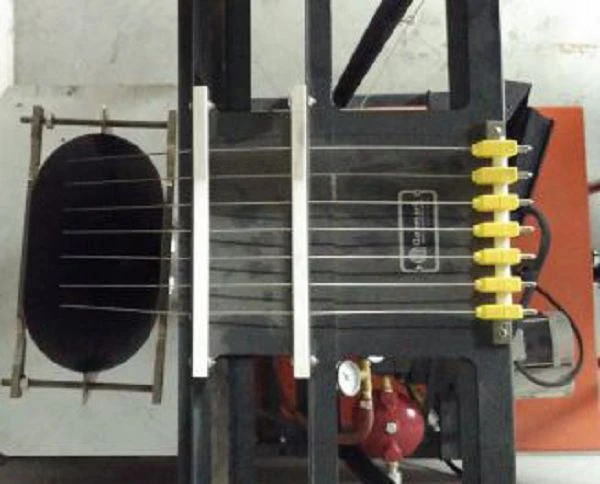
- Seven imported American K-type thermocouples, 304 metal sheathed, diameter 1.6 mm, for real-time flame temperature collection with 1 C accuracy.
- Seven imported American K-type thermocouples, 304 metal sheathed, diameter 3 mm, optional for FAA test requirements.
- Equipped with sliding thermocouple adjustment structure for simple and convenient temperature calibration positioning.
- Exclusive calibration frame design meets 0 degrees, 45 degrees, and 90 degrees calibration requirements; the burner can move from calibration position to specimen test position without moving the calibration frame.
- 16-bit high-performance temperature acquisition module with sampling frequency 1 Hz.
- Thermocouple installation position is 203 ±3 mm from the burner conical outlet, and the average temperature within 30 seconds is not less than 871 C.
8. Burner Combustion System and Software
- Independent air circuit and fuel circuit control cabinet enables remote control of the entire experiment without moving between control units.
- Independent test operation control cabinet allows real-time adjustment of gas pressure, air flow, fuel pressure, and fuel flow at the test position.
- Labview operation software with friendly, concise, and visually clear interface and modular design.
- Labview computer control system provides automatic ignition, automatic test-process control, and test-data recording with data acquisition frequency up to 1 Hz.
- Air solenoid valve and fuel solenoid valve automatically control on-off of air and fuel.
- Computer-controlled spark plug automatic ignition system automatically generates temperature and heat flux curves.
- Equipped with automatic ignition system.
- Equipped with flame calibration system.
- Equipped with heat flux density calibration system.
- Test process is automatically controlled by computer.
- System automatically generates test reports.
- Test report includes burnthrough time, maximum heat flux on the exposed surface of thermal and acoustic insulation blanket specimens, and the time at which the maximum heat flux occurs.
- Large-screen LCD display system provides real-time monitoring of the combustion test process.
- Automatic translation and rotation system with position learning and memory function.
Technical Parameters
|
Parameter |
Value |
|
Model |
TTech-MHT6086 |
|
Power Supply |
AC 220V, 50/60Hz |
|
Maximum Power |
2000 VA |
|
Flame Temperature |
0 to 1100 C adjustable |
Laboratory Environment Required from Customer
- Recommended laboratory space larger than 6 m long, 3 m wide, and 3 m high.
- Laboratory shall be equipped with smoke extraction facilities.
- The laboratory must not have moving air. Doors and windows should remain closed during testing, otherwise the burner heat field will be affected.
- The combustion room shall be equipped with fire-extinguishing facilities.
- Large air compressor and compressed-air storage tank required.
- Nitrogen cylinder required.
Accessories Supplied
- Several high-pressure oil hoses in 2-point, 6-point, and 1-inch sizes.
- Several 6-point high-pressure air hoses.
- Several stainless steel pipe clamps, hose clamps, buckles, and screws.
- One pair of fire-resistant high-temperature gloves.
- Several oil tank sealing rings.
- Several high-temperature silicone tubes.
- One manual refueling device set.
Additional Notes on First-Generation and Second-Generation Burners
- The first-generation burner required redesign and modification based on the standard-specified burner brand and model to provide fixed airflow and oil flow.
- The first-generation burner had instability in flame and heat output.
- The burner brand and model specified in the original standard were discontinued.
- After identifying these issues, the FAA began developing a second-generation burner. Based on extensive study of foreign second-generation burner documentation, TESTech successfully developed a fully compliant second-generation aviation burner after more than one year of design and development. It has already been delivered for use by Aero Engine Corporation of China.
Hot Tags: aircraft fire penetration tester, China aircraft fire penetration tester manufacturers, suppliers, factory


