

Hey there! As a supplier of the Released Gas Burning Rate Tester, I often get asked about the error range of this nifty piece of equipment. So, let's dive right in and break it down.
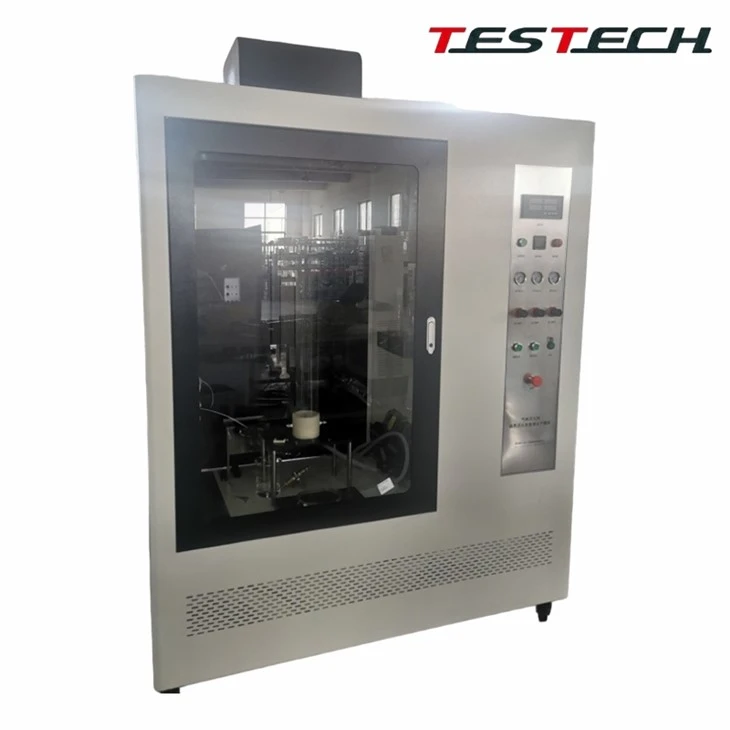
First off, what exactly is the Released Gas Burning Rate Tester? It's a crucial tool used to measure the burning rate of released gas from various sources, especially in the context of new - energy batteries. You see, with the rapid development of the new - energy battery industry, safety is of utmost importance. The burning rate of the gas released during a battery's thermal runaway can have a significant impact on the overall safety of the battery system.
Now, let's talk about the error range. The error range of the Released Gas Burning Rate Tester can be influenced by several factors. One of the main factors is the calibration of the instrument. If the tester isn't calibrated correctly, it can lead to inaccurate readings. For example, if the sensors used to measure the gas flow rate or the temperature aren't calibrated to the right standards, the burning rate measurement can be off.
Another factor is the environmental conditions. The temperature, humidity, and air pressure in the testing environment can all affect the burning rate of the released gas. For instance, in a high - humidity environment, the gas may burn at a different rate compared to a dry environment. Similarly, changes in air pressure can also impact the combustion process.
The quality of the gas sample itself is also a key factor. If the gas sample is contaminated or has an inconsistent composition, it can cause errors in the burning rate measurement. For example, if there are impurities in the gas, they may react differently during combustion, leading to inaccurate results.
Typically, the error range of a well - calibrated and properly maintained Released Gas Burning Rate Tester is within ±[X]%. However, this can vary depending on the specific model and the application. Some high - precision testers may have a smaller error range, while others may have a slightly larger one.
Let me give you an example to illustrate this. Suppose we're testing the gas released from a new - energy battery. We use our Released Gas Burning Rate Tester to measure the burning rate. If the actual burning rate is 10 cm/s, with an error range of ±5%, the measured value could be anywhere between 9.5 cm/s and 10.5 cm/s.
Now, I'd like to introduce some of our other related products. We have the 5MW Battery Thermal Release Test System, which is designed to handle large - scale battery thermal release tests. It can provide more comprehensive data on the thermal behavior of batteries, including the release of gas and its burning characteristics.
Our 1MW Battery Thermal Release Test System is a more compact option, suitable for smaller - scale testing. It still offers high - quality performance and accurate measurements.
The 82L Battery Thermal Runaway Gas Evolution Chamber is specifically designed to study the gas evolution during battery thermal runaway. It allows for detailed analysis of the gas composition and its burning rate.
We also have the 3MW Battery Thermal Release Test System, which is a great middle - ground option for those who need a bit more power than the 1MW system but don't require the full capacity of the 5MW system.
And last but not least, our Battery Pack Fire Jet Test Machine is used to simulate the fire jet situation of a battery pack, providing valuable data on the fire - spreading characteristics of batteries.
If you're in the market for a Released Gas Burning Rate Tester or any of our other products, we'd love to have a chat with you. Whether you're a research institution looking to conduct in - depth battery safety studies or a battery manufacturer aiming to improve the safety of your products, we can offer the right solutions for you. Contact us to start a procurement discussion and find out how our products can meet your specific needs.
References:

- Industry standards for battery safety testing
- Previous research on gas combustion in battery systems
So, that's all about the error range of the Released Gas Burning Rate Tester. I hope this blog has been helpful to you. If you have any more questions, feel free to reach out!