

If you’ve ever walked past a construction site, you’ve probably noticed tons of building materials being hauled in—drywall, insulation, foam boards, steel beams, the works. But have you ever stopped to think about how these materials hold up when they catch fire? That’s where building material flammability apparatus come in, and as a supplier of these tools, I get asked this question all the time: “What’s actually going on inside that tester when I run a sample?” Let me break it down like I would with a new client or a colleague—no stuffy jargon, just the straight, science-backed truth.
First off, let’s get one thing clear: these aren’t just random machines that light a match and watch stuff burn. They’re precision tools built to mimic real-world fire scenarios, but in a controlled lab setting. The measuring principle boils down to a few core steps—controlled sample preparation, targeted fire exposure, real-time data tracking, and standardized outcome scoring. Each step is non-negotiable, because if you cut corners, the test results won’t mean squat.
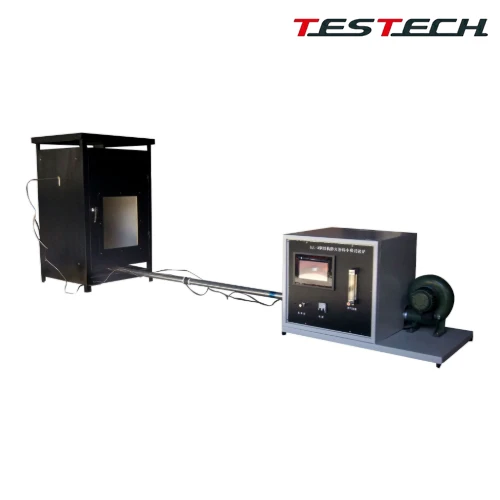

Let’s start with the sample. You can’t just grab a random chunk of foam from a job site and toss it in. Every flammability test requires samples that follow strict dimensions based on the standard you’re using—whether that’s ASTM, ISO, or your local regulatory body’s rules. For example, if you’re testing rigid foam insulation for wall panels, the sample has to be cut to exact length and width, no jagged edges, no uneven thickness. Why? Because if a sample is thicker than it should be, it might burn longer than a real-world piece of the same material, skewing your results. That’s why so many of our clients rely on our Hard Foam Vertical Burning Test Instrument for these foam-specific tests— it’s calibrated to hold just the right size hard foam samples every single time.
Next, the fire exposure part. This is where the principle gets specific. Different fire scenarios need different heat sources, right? A small kitchen fire is nothing like a big warehouse blaze, so we build apparatus to match. Most flammability testers use either a Bunsen burner or a radiant heat source, and they’re set to a exact heat output. For example, vertical burning tests for building materials use a flame that’s 20mm tall, applied to the bottom of a vertical sample for 10 seconds. The measuring part here is tracking how long the flame lasts after you move the burner away, and if the molten material drips and keeps burning. Those drips are a big deal—they’re a safety hazard because they can spread fire to other materials, so that’s a key data point.
Wait, but not all fire tests are vertical. Some building materials, like steel structure fire retardant coatings, need different testing because their job is to protect steel from high heat, not just resist burning. That’s where our Steel Structure Fire Retardant Coating Samples Test Furnace comes in— it uses a controlled furnace chamber that heats the steel sample to temperatures that mimic a real fire, and measures how long the coating keeps the steel below a critical temperature (usually 500°C, where steel loses most of its strength). That’s a totally different measuring principle: instead of tracking flame spread, it’s tracking heat transmission over time.
Another key piece of the measuring principle is real-time data collection. These aren’t just old machines with stopwatches—our modern flammability apparatus have sensors built right in. Some track temperature at multiple points in the test chamber, some track the speed of flame spread along the sample, some even measure smoke density as the material burns. Smoke is actually a huge fire killer—most people don’t die from flames, they die from toxic smoke—so that data is just as important as how fast a material burns. If you need to test smoke output, our Building Material Smoke Density Tester uses a light sensor to measure how much smoke obscures a light beam, which is a standard way to quantify smoke density for building codes.
Let’s talk about one of the more complex testers, the Room Corner Tester. This one’s designed to mimic a real fire in a room corner, where walls, ceiling, and a corner all meet— that’s a common place fires start and spread fast. The measuring principle here is way more involved: it’s a full-scale test (not a tiny sample) with actual room dimensions, and it measures heat release rate, flame spread along the walls, and how much heat is generated over 20 minutes. That’s way different from a small vertical test, because it’s not just a sample burning—it’s a whole assembly interacting with fire.
I should also mention a related test that a lot of our clients ask about: ignition temperature. Knowing at what temperature a material will catch fire is super important for choosing the right materials for walls, ceilings, etc. That’s why our Ignition Temperature Tester is a go-to for so many customers. The measuring principle here is heating a small sample gradually, and using a sensor to detect when the first tiny flame appears. It’s not just “light a match and see”— it’s precise, controlled heating and detection, so you get accurate ignition temperature numbers that you can trust for code compliance.
Wait, let’s make sure I’m not mixing up the principles too much. At the end of the day, every building material flammability apparatus works on two core, unchanging measuring rules: 1) All test conditions are standardized—no variations in heat, sample size, test duration, or equipment settings, and 2) Results are quantifiable, not just subjective. You don’t get a “sort of flammable” score; you get a number—time to ignition, flame spread rate, smoke density, heat release rate—and compare that to national or international standards. That’s the whole point—so architects, builders, and code officials know exactly how a material will perform in a fire, no guesswork.
I’ve seen a lot of people cut corners here—trying to use a cheap tester that doesn’t meet standards, or cutting sample sizes to save time. But here’s the thing: if your test results are wrong, that’s a safety risk. A builder might use a material that looks good on paper but fails in a real fire, and that’s not worth it. That’s why I prioritize making sure our apparatus are calibrated to the latest standards—so every test you run is reliable, and the results you get will pass code checks every time.
For example, a contractor testing foam insulation for a new apartment building needs to know if it meets the local fire code, which requires a 30-second flame-out time after the burner is removed. Using our Hard Foam Vertical Burning Test Instrument, they can run that test, get exact data on how long the flame lasts, if there are any burning drips, and that’s all documented for their building permit. No surprises, no rework, no delays.
Another example: a steel fabricator applying fire retardant coating to a beam for a office tower. They need to prove the coating will keep the steel strong for at least 2 hours in a fire. Using our Steel Structure Fire Retardant Coating Samples Test Furnace, they can heat the coated steel, track the steel’s temperature over time, and show it stays below 500°C for the full 2 hours. That’s non-negotiable for getting the beam approved.
And for interior finishes, like wall panels or ceiling tiles, the Room Corner Tester is perfect because it simulates how a fire would actually spread in a room. It’s not a small sample test, so the results are way more accurate for real-world use. A lot of cities require this test for public buildings—schools, hospitals, malls—so having a reliable Room Corner Tester on hand is a must for any material supplier or testing lab.
I get asked all the time, “How do I know if my tester is measuring correctly?” The short answer: make sure it’s calibrated regularly, using reference materials that have known flammability values. For example, if you test a sample of cotton (which has a known ignition temperature) with your Ignition Temperature Tester, it should give you a number within a few degrees of the standard. If it’s off, you need to adjust it. That’s a key part of the measuring principle—calibration isn’t a one-time thing, it’s ongoing to make sure the data stays accurate.
Also, smoke density is a big one I touched on earlier. A lot of people forget that smoke is the leading cause of fire deaths, so testing how much smoke a material gives off is just as important as how fast it burns. Our Building Material Smoke Density Tester uses a small combustion chamber, burns the sample, and measures how much light is blocked by the smoke. That number is used in building codes to make sure that in an emergency, people can see to escape, which is a huge safety factor.
Let me wrap this up. The measuring principle of any building material flammability apparatus is all about controlled, standardized testing that translates real-world fire risks into quantifiable data. No guesswork, no subjective judgments—just precise tools and methods that give you results you can trust for safety, code compliance, and building a better, safer structure.
If you’re in the market for a reliable flammability tester—whether it’s for hard foam, steel coatings, smoke testing, or full-scale room corner tests—I’d be happy to help you find the right one for your needs. Don’t hesitate to reach out to us for more details or to discuss your specific testing requirements.
References
- ASTM E1354, Standard Test Method for Heat and Visible Smoke Release Rates for Materials and Products Using an Oxygen Consumption Calorimeter
- ISO 11925-2, Reaction to fire tests for building products — Ignitability testing for products exposed to direct impingement of flame — Part 2: Single flame source test
- NFPA 286, Standard Method of Fire Tests for Evaluating Contribution of Wall and Ceiling Interior Finish to Room Fire Growth
- ASTM D1929, Standard Test Method for Ignition Temperature of Plastics