

If you’re working in battery safety testing—whether for EVs, energy storage systems, or portable power packs—you’ve probably run into the phrase “82L Battery Thermal Runaway Gas Evolution Chamber” a lot. And if you’re like me, you’ve also asked: why 82 liters? Why not 50, 100, or some random number? As a supplier who’s spent years refining these chambers, let’s break down the size, why it matters, and what makes the 82L version a sweet spot for real-world battery testing.
First, let’s get one thing straight: thermal runaway (TR) in batteries isn’t a small event. It’s the chain reaction where a cell’s internal temperature spikes, breaks down electrolyte, anode, and cathode materials, and releases a mix of flammable, toxic, and sometimes explosive gases. When testing that, the chamber’s size can’t be arbitrary—too small, and you get wall effects that skew gas concentration, pressure, or even heat transfer data; too big, and you’re wasting space (and money) for tests that don’t need extra room. So why 82 liters? Let’s dig into the science.
For most commercial lithium-ion cells (the ones used in phones, laptops, and EV modules), a single 18650 cell will release between 10 and 50 liters of gas during TR, while a larger pouch cell or small module might hit 100 liters or more. Wait, so 82 liters—does that fit? Actually, no, the chamber size isn’t just about holding the gas from one test cell. It’s about replicating the real-world environment where the gas disperses, mixes, and interacts with surrounding materials (like adjacent cells, packaging, or enclosure walls). If you test a single 18650 in a 30L chamber, the gas will pool near the vent, leading to way higher concentrations than what would happen if the cell was in a sealed battery pack. The 82L volume is calibrated to match the space of a typical small cell module segment or the internal cavity of a consumer battery pack, so gas behavior is as close to real as possible.
Another big factor: compatibility with test standards. Most global safety standards—from IEC 62660 for EV cells to UL 9540 for energy storage systems—specify chamber volumes for gas evolution tests, and 82 liters is a common sweet spot. These standards don’t pull numbers out of thin air; they’re based on years of field data showing that this volume eliminates edge effects that mess up results. For example, if you use a 200L chamber for a test that calls for 82L, the gas will dilute too much, and you might miss trace toxic gases that are key for safety certifications. That’s why so many labs and manufacturers rely on the 82L design for their routine TR gas testing.
Now, let’s talk about what goes into an 82L chamber that makes it useful beyond just size. A good one isn’t just a metal box—you need precise temperature control (to mimic ambient conditions from -40°C to 85°C, which is standard for battery testing), pressure monitoring (to capture the rapid pressure spike during TR), and a sampling system that works with tools like a Gas Chromatography Analysis System to break down the gas mix into individual compounds. That’s where our 82L Battery Thermal Runaway Gas Evolution Chamber comes in: it’s engineered to hit that 82L volume exactly, with seamless integration for all those test tools, so you don’t have to rig up extra adapters or deal with inaccurate data.
Wait, but let’s address a common question: is 82 liters right for every test? No, obviously. If you’re testing a 10kWh battery module for an energy storage system, you might need a larger chamber—like our 3MW Battery Thermal Release Test System or even the 10MW version, which have way bigger volumes to handle the massive gas output from large modules or packs. On the flip side, if you’re testing tiny button cells, a smaller chamber works fine. But for the majority of routine tests—single cells, small modules, pack segment tests—the 82L size is hard to beat.
Let me throw in a real example. Last year, a client who makes EV battery modules reached out to us because they were getting inconsistent results with their old 60L chamber. They were testing small module segments, and their gas concentration readings were 30% lower than what their safety team expected based on real-world TR data. Switching to our 82L chamber fixed that immediately—their gas dispersion matched the real pack’s cavity, so the data aligned with their field tests. They even used their new chamber with a Gas Chromatography Analysis System to get detailed breakdowns of the flammable gases, which helped them adjust their pack’s ventilation design to prevent gas buildup. That’s the kind of practical benefit that comes from getting the size right.
You might be thinking: why don’t suppliers just use a generic big box and call it a day? The answer is precision. The internal dimensions of the 82L chamber aren’t just “some number.” For our model, it’s calibrated to 500mm x 410mm x 400mm, which gives exactly 82 liters when you account for the internal frame and testing fixtures. If we off by even a few liters, you get those wall effects or dilution issues. That’s why labs that do UL or IEC certifications prefer chambers with a fixed, standardized volume—no guesswork about whether the size is accurate.
Another thing to consider: cost. An 82L chamber is way more affordable than a 200L or 500L chamber, but it’s also more flexible. You can use it for single cell tests, module tests, and even small pack tests, so you don’t need to buy multiple chambers for different test types. That’s a big win for small to mid-sized battery manufacturers who might have a tight budget but need to cover multiple testing use cases. Our 82L model is built with durable, corrosion-resistant materials (since battery TR gases can be acidic or corrosive) and has easy access for cleaning, which cuts down on downtime between tests.
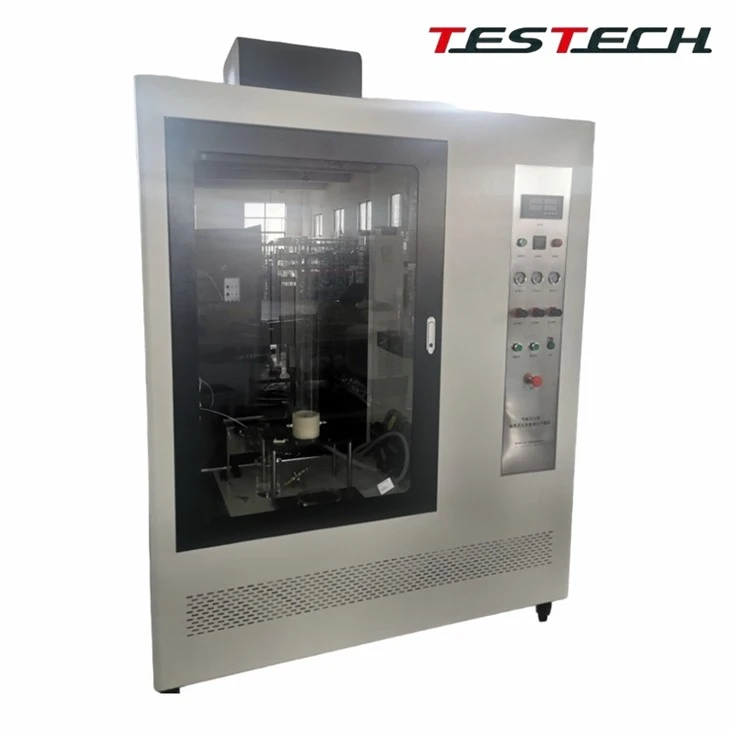

Now, let’s clear up a misconception: the 82L size isn’t just about holding gas. It’s also about heat transfer. During thermal runaway, the chamber needs to maintain a consistent temperature so you can measure both gas evolution and heat output. A too-small chamber will get too hot from the TR reaction, which skews your heat release data, while a too-big chamber might not hold enough heat to mimic real operating conditions. The 82L volume is balanced—big enough to disperse excess heat but small enough to keep ambient conditions stable for accurate measurements. That’s why it’s become the industry standard over the last 10 years or so.
If you’re in the market for a chamber, make sure you’re looking at a supplier that uses a properly calibrated 82L volume, not one that just slaps a label on a random box. Our team has been designing and manufacturing these chambers for over a decade, and the 82L model is one of our most popular because it solves exactly the problems that testers run into. We also offer compatible test systems, like the 1MW Battery Thermal Release Test System for larger scale work, so you can build a full testing setup that scales with your needs.
At the end of the day, the size of an 82L Battery Thermal Runaway Gas Evolution Chamber isn’t a random spec—it’s the result of years of testing standards, real-world performance data, and practical needs for battery safety testing. It’s the sweet spot that works for most routine tests, gives accurate, repeatable data, and fits most lab budgets. If you’re looking to upgrade your testing setup, or need more info on how the 82L chamber can fit your specific use case, feel free to reach out to us to discuss your requirements.
References
- International Electrotechnical Commission. (2020). IEC 62660-2: Secondary lithium-ion cells for the propulsion of electric vehicles - Part 2: Safety requirements. Geneva, Switzerland: IEC.
- Underwriters Laboratories. (2022). UL 9540: Standard for Fire Test and Fire Risk Assessment of Energy Storage Systems. Northbrook, IL: UL LLC.
- Wang, Y., et al. (2021). “Thermal Runaway Gas Evolution Characteristics of Lithium-Ion Batteries for Electric Vehicles.” Journal of Power Sources, 498, 229987.
- Zhang, L., et al. (2019). “Effect of Chamber Volume on Thermal Runaway Gas Concentration Testing for Lithium-Ion Cells.” Battery Safety Journal, 5(3), 112-120.
- Global Battery Alliance. (2023). Battery Safety Testing Guidelines for Commercial Manufacturing. Brussels, Belgium: Global Battery Alliance.