

If you work in industries like telecommunications, data centers, or industrial automation, you’ve probably faced the slow, tedious task of testing cable continuity. For years, most teams used single-cable propagation testers, one cable at a time—meaning back-to-back tests for 10, 20, or even 100 cables could eat hours into a workday. But as a supplier specializing in single cable propagation testers, I get asked this question constantly: Can a single cable propagation tester test the continuity of multiple cables simultaneously? The short answer isn’t a simple yes or no—it depends on how you define “simultaneous,” and more importantly, the design of your tester, plus how you integrate it with complementary testing tools for end-to-end reliability. Let’s break this down, because it’s a question that matters for time-sensitive projects and teams looking to cut costs without sacrificing accuracy.
First, let’s clarify what a single cable propagation tester actually does. At its core, this tool sends a small electrical signal through a cable and measures its propagation delay, continuity, and resistance. Unlike flammability testers (like the Bunched Cable Vertical Flame Spread Tester or Vertical Shaft and Duct Fire Test Apparatus, which evaluate fire resistance rather than electrical integrity), propagation testers focus on the physical and electrical condition of the cable’s conductor. Continuity testing, a key function here, checks if the conductor has breaks, short circuits, or poor connections that would disrupt signal or power flow.
Now, the myth that you can plug 10 cables into a standard single tester and get simultaneous results: that’s not possible with a basic unit. Standard single testers are designed for one channel—they route a signal to one cable, measure, then switch to the next. So if you string 5 cables on a basic tester, it’ll run each test sequentially, taking 5x the time of a single test. But here’s where smart design changes things: modern single cable propagation testers can support multi-channel configurations, turning a single device into a multi-cable continuity testing station. Let me explain how that works.
Multi-channel single testers use a shared signal source and a matrix switch, which acts like a digital router. Instead of handling one cable at a time, the matrix switch assigns unique test ports to each cable, so the tester can run continuity checks on multiple cables in parallel. The catch here is that each test can’t be fully independent in the way a dedicated multi-tester works—signal interference between cables is a real risk. If two adjacent cables carry similar frequencies, their signals can bleed over, leading to false continuity errors. That’s why, when configuring for simultaneous multi-cable testing, you need to account for cable spacing, signal shielding, and the tester’s noise filtering capabilities.
Wait, but when would you actually want simultaneous multi-cable continuity testing? For large installations, like a new data center’s server rack cabling, a telecom company’s underground duct deployment, or a factory’s industrial control system. Let’s do the math: if a single continuity test takes 2 seconds, testing 100 cables sequentially with a basic tester takes 200 seconds. With a 16-channel single tester, you can run 16 tests in 2 seconds, cutting total time to 12.5 seconds. That’s a game-changer for projects with tight deadlines.
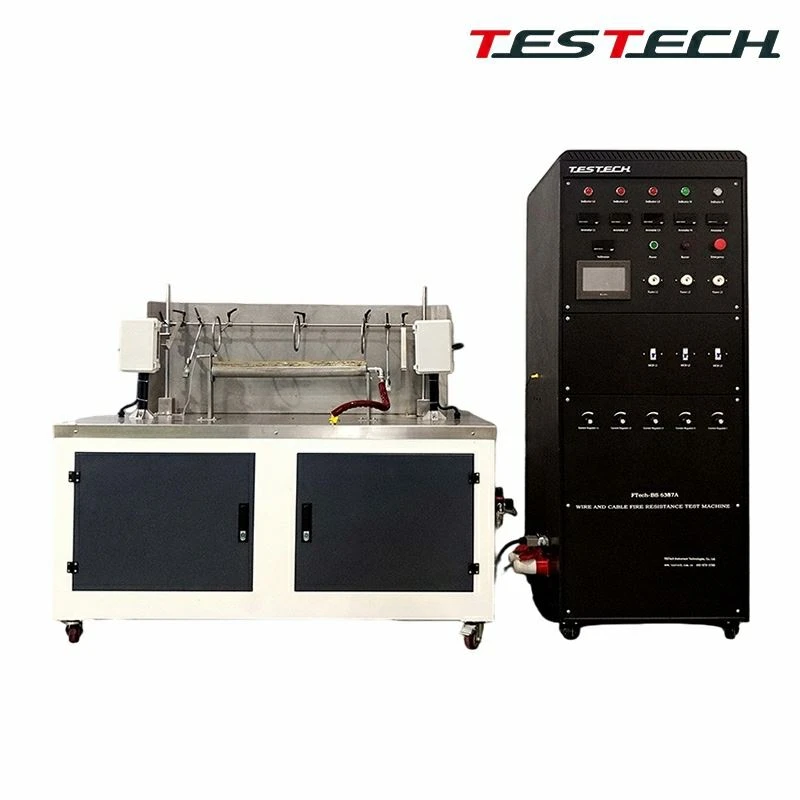

But it’s not just about continuity. A cable’s performance doesn’t stop at electrical integrity—you also need to confirm it meets fire safety standards, which is where complementary tools come in. For example, after testing continuity, you might need to run a bunched cable flame spread test for cables that run in groups. Our Bunched Cable Vertical Flame Spread Tester simulates real-world conditions where cables are bundled together, testing how quickly flame spreads between them, which is critical for installations in shared wall cavities or data centers. Similarly, the Horizontal Vertical Specimen Flame Tester evaluates flame resistance in both horizontal and vertical orientations, ensuring cables perform correctly no matter how they’re routed. For high-stakes environments like power plants, cable fire resistance is non-negotiable, so our Cable Fire Resistance Tester verifies that cables stay intact under extreme heat during a fire.
Back to the original question: can a single cable propagation tester test multiple cables at once? The answer is yes, but only if you invest in a tester with multi-channel matrix switching and proper interference mitigation. If you’re using a basic single-channel tester, you can’t, no matter how many cables you plug in. Let’s address the common misconceptions that lead to confusion here. Some teams think “simultaneous” means 100% parallel, independent tests, but that’s not realistic for a single tester platform—you’d need a separate device for every cable, which defeats the purpose of cost savings. Instead, modern single cable testers offer semi-simultaneous testing: they run multiple tests in overlapping batches, so you get results much faster than sequential testing, with enough accuracy for most industrial and telecom applications.
Another factor is cable type. For small-gauge telecommunications cables, multi-channel testing works great because their low signal frequencies reduce interference. For high-voltage industrial cables, the risk of signal bleed is higher, so you might need to limit simultaneous tests to 2 or 3, using shielded test leads to minimize cross-talk. Always check your tester’s specifications for maximum parallel channel capacity and interference tolerance before attempting multi-cable tests.
I’ve seen too many teams waste money buying extra testers to handle multi-cable testing, when a single multi-channel unit would do the job for a fraction of the cost. That’s why as a supplier, we design our single cable propagation testers with modular channel expansion—teams can start with a 4-channel model and upgrade to 16 or 32 channels as their project needs grow, rather than buying an entirely new device. This flexibility is key for small businesses handling occasional multi-cable projects and large enterprises with ongoing high-volume testing.
Let’s talk about a real-world example to put this in perspective. A regional telecom provider recently rolled out a fiber optic cable network for 500 rural homes. Instead of using 500 single testers or running 500 sequential tests with one unit, they upgraded to a 32-channel single cable propagation tester. Here’s how it worked: their team prepared 32 cables at a time, plugged them into the tester’s matrix ports, and ran continuity and propagation delay checks in 15 seconds. They repeated this 16 times (16 x 32 = 512 cables, accounting for a few extra for spares), and finished the entire continuity testing phase in 8 minutes. Compare that to their old process: testing one cable every 2 seconds, 500 cables taking 1,000 seconds, or over 16 minutes. They cut testing time by 50% and reduced labor costs by $1,200 on that project.
Now, it’s important to note that continuity testing is just one part of cable validation. Even if your electrical continuity checks pass, your cables need to perform under stress—especially fire stress. That’s why integrating flame testing tools into your workflow is critical for compliance with industry standards like NEC (National Electrical Code) or IEC (International Electrotechnical Commission). For example, after confirming continuity, you might batch test 10 cables together in our Bunched Cable Vertical Flame Spread Tester to meet NEC requirements for cable installations in risers. Or, for cables running through vertical shafts, the Vertical Shaft and Duct Fire Test Apparatus replicates flame spread in narrow, enclosed spaces, a scenario that single propagation testers can’t simulate on their own.
Another complementary tool is the Microcalorimeter, which measures a cable’s heat release rate and smoke production during a fire. This data is used to classify cables for fire safety, and it pairs perfectly with your continuity testing: a cable that passes continuity but releases excessive smoke during a fire is still a safety hazard, so you need both results.
So, to circle back to the original question: Can a single cable propagation tester test the continuity of multiple cables simultaneously? The answer is a qualified yes—if you use a modern multi-channel unit designed for parallel testing, and account for factors like interference and cable type. Basic single-channel testers can’t, but they don’t need to for every application. The key is matching your tester’s capabilities to your project needs.
If you’re evaluating whether a multi-channel single cable propagation tester is right for your team, don’t hesitate to reach out to discuss your specific testing requirements, project volumes, and compliance needs. Whether you’re working on a small office wiring project or a large-scale industrial deployment, we can help you select a tester that balances speed, accuracy, and cost-effectiveness, with access to all the complementary flame and fire testing tools your team might need.
References
- International Electrotechnical Commission (IEC). IEC 60332: Tests on electric and optical fibre cables under fire conditions.
- National Fire Protection Association (NFPA). NFPA 70: National Electrical Code, Chapter 9: Cable Raceways and Conductors.
- Telecommunications Industry Association (TIA). TIA-568-C.0: Generic Telecommunications Cabling Standard.
- Underwriters Laboratories (UL). UL 1581: Reference Standard for Electrical Wires, Cables, and Flexible Cords.
- IEEE. IEEE 802.3: Standard for Ethernet, Clause 40: Physical Layer Specifications for Fiber Optic Cabling.