

If you work in fire safety testing for construction, furnishings, or building materials, you’ve probably heard the term “Room Corner Tester” thrown around—but you might be wondering: what is its actual size? As a supplier of specialized fire testing equipment, I get this question all the time. Customers, lab managers, and even new technicians often assume it’s a huge, room-sized contraption, or conversely, a small benchtop tool barely bigger than a microwave. The truth is, the size of a typical Room Corner Tester is a balance between regulatory requirements, test accuracy, and practical lab space. Let’s break down what matters, why size isn’t one-size-fits-all, and what you can expect when you invest in one.
First, it’s critical to ground this in what a Room Corner Tester does. Named for its design—it mimics a 90-degree corner of a room, the most common ignition point for growing fires in real-world spaces—it’s used primarily to test the surface flammability of materials like wall coverings, insulation, upholstery, and mattresses. Regulatory bodies like ASTM E1354, ISO 9705, and national building codes worldwide mandate that products pass this test before they hit the market. The test involves igniting a small pilot flame, tracking how quickly flames spread up the two intersecting walls of the corner, and measuring heat release and smoke production over 20 minutes.
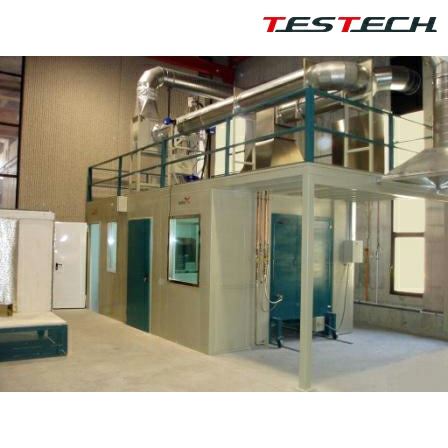

Given that goal, the internal test chamber can’t be too small—scaling down the space would skew results, making them irrelevant to real fire behavior. But it also can’t be so large that it’s impractical for mid-sized or small testing labs. As a supplier, I’ve designed and sold hundreds of these testers, and I can tell you that the standard typical size is tailored to balance these needs. Let’s get specific: the internal test chamber (the core space where the test happens) is built to replicate a scaled-down but functional room corner. The two main vertical test walls, which are usually interchangeable to test different materials, are each 2.4 meters (8 feet) tall and 0.9 meters (3 feet) wide. They meet at a perfect 90-degree angle to form the corner. The ceiling of the chamber is 0.9 meters above the top of the test walls, to capture any flames that reach upward without restricting air flow.
Wait, you might be thinking, that’s the test space—what about the rest of the unit? The entire external unit, including the control panel, exhaust system, and data logger, adds a bit more bulk. The full footprint of a typical Room Corner Tester is approximately 3 meters (10 feet) in length, 2 meters (6.5 feet) in width, and 3.5 meters (11.5 feet) in height. That works out to a total volume of about 21 cubic meters, which is roughly the size of a small shipping container, or half the size of a standard parking space. It’s big, but not so big that it requires a custom-built lab or a dedicated warehouse. I’ve installed many of these in labs with as little as 25 square meters (270 square feet) of dedicated space, as long as there’s access to an exhaust system and power.
Of course, not every Room Corner Tester is identical. There are compact models for labs that are tight on space, and larger high-capacity versions for testing bulk materials like insulation or large mattresses. The key difference between standard and compact models is usually the height of the test walls—compact units might have walls that are 1.8 meters (6 feet) tall, which still meets most local code requirements for smaller-scale testing, though they’re not ideal for full-size wall coverings. For the most accurate, full-scale tests, though, you want the standard size I mentioned earlier.
Now, why does size matter beyond fitting in your lab? The dimensions directly impact test results. If the chamber is too small, the flames can’t develop fully—they’ll hit the ceiling or side walls too early, leading to underreported heat release and slower flame spread, which means your product could pass a test that wouldn’t hold up in a real fire. I see this all the time when customers try to cut corners with cheap, undersized testers; their results don’t align with third-party lab testing, so they end up redoing tests anyway. Investing in a standard-sized Room Corner Tester ensures your data is reliable and accepted by regulatory bodies, which saves time and money in the long run.
As someone who’s spent years working with testing labs and manufacturers, I also know that size isn’t the only factor when choosing fire testing equipment. You’ll need to pair your Room Corner Tester with tools that measure smoke density, heat release, and toxicity, all of which are part of a full fire safety assessment. For example, if you’re testing building materials, you might want to add a Building Material Smoke Density Tester to measure how much smoke is produced during combustion—critical for egress during a fire. For insulation materials, a Thermal Load Tester for Thermal Insulation Rock Wool can help you understand how thermal properties interact with fire behavior, which is useful for building code compliance. If you’re testing mattresses or upholstered furniture, a Flammability Of Mattress Sets Test Apparatus is tailored to those specific products, ensuring you meet standards for bedding fire safety. For even more comprehensive data on smoke toxicity, a Materials Smoke Production Toxicity Test Device can measure the harmful gases released when materials burn, which is essential for assessing human safety during fires.
When I help a customer figure out their equipment needs, I always start with their core application. A small furniture manufacturer might only need a compact Room Corner Tester for internal quality control, while a large construction materials supplier will need the full standard unit to meet global regulatory requirements. Space is a big consideration, too—some labs are in industrial buildings with high ceilings, so a taller unit is easy to accommodate, while others are in clean rooms with lower ceilings, so a compact model is the only way to go.
I’ve had customers reach out and ask if they can put a Room Corner Tester in a standard office space, and the answer is almost always no. Between the size, the exhaust system that needs to vent outside, and the high power requirements (most units need 3-phase power), these are lab-grade tools that belong in dedicated testing spaces. That said, the footprint is manageable for most mid-sized labs—unlike some other large fire testing equipment, like full-scale room burn chambers, the Room Corner Tester is designed to be modular and installable in existing lab spaces with minimal customization.
Another common question: how much do size variations affect cost? Generally, the larger the test chamber, the higher the price, but it’s not a linear increase. The standard unit I described earlier has a robust stainless steel chamber, precise ignition system, and data logging capabilities, which are worth the investment for long-term reliability. A compact model might cost 20-30% less, but it’s limited in the types of tests it can perform, so if you plan to expand your product line or need to meet multiple regulatory standards, the standard size is a better value.
If you’re in the market for a Room Corner Tester, or you’re looking to upgrade your existing equipment, it’s important to work with a supplier that understands the nuances of size, regulatory compliance, and lab needs. I’ve spent years refining our units to meet global standards, and we offer both standard and compact models to fit different space and budget needs. We also provide installation support, calibration services, and training to ensure your team can use the equipment safely and accurately.
At the end of the day, the size of a typical Room Corner Tester is the result of decades of fire safety research and regulatory testing. It’s not arbitrary—it’s sized to replicate real fire behavior as accurately as possible, while still being practical for labs to use. Whether you’re a small business testing a new line of wall coverings or a multinational corporation ensuring your products meet strict global codes, knowing this size helps you plan your lab space, budget, and testing needs.
If you’re ready to explore your options for a Room Corner Tester, or you want to learn more about how to pair it with other testing tools to meet your fire safety goals, don’t hesitate to reach out. We work with labs, manufacturers, and regulatory bodies worldwide, and we can help you find the right equipment for your specific needs. For more details on our Room Corner Tester, visit our product page. We also offer a range of complementary fire testing equipment to support all your testing needs, so you can build a comprehensive lab that meets all regulatory requirements.
References
ASTM International. (2020). Standard Test Method for Room Corner Test for Surface Flammability of Materials (E1354). ASTM International.
International Organization for Standardization. (2018). Reaction to Fire Tests for Building Products – Full-Scale Room Test (ISO 9705). ISO.
National Fire Protection Association. (2021). Standard Methods of Fire Tests for Surface Flammability of Materials (NFPA 286). NFPA.